
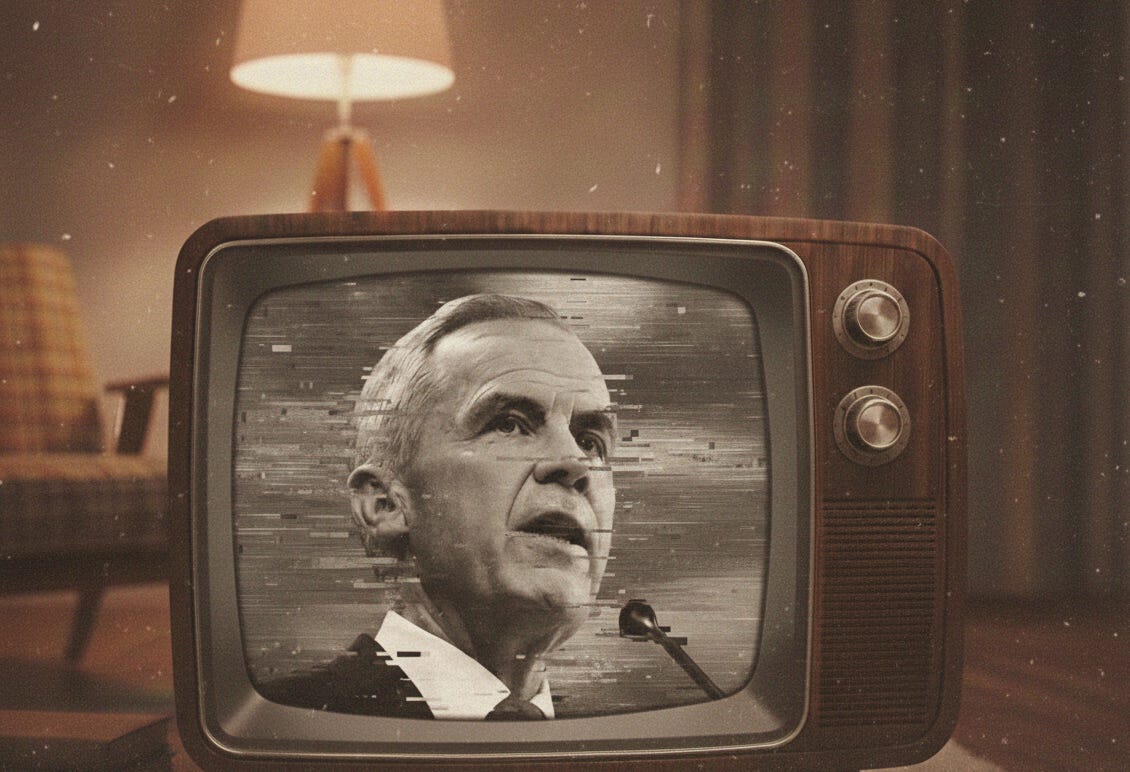
I listened to Carney at Davos and, credit where it’s due, I enjoyed it. The guy can speak. He’s precise, controlled, and he knows how to land a line without sounding like he’s selling you something. As pure delivery, it’s impressive.
Carney’s message, stripped of polish, is essentially this: the world is getting harder, the guardrails are coming off, and Canada can’t coast on reputation anymore. Canada is entering a decade where speed compounds and delay becomes permanent. Our institutions are built to delay. That mismatch is the story.
The part that matters isn’t the speech. It’s what it reveals about how we keep thinking. We still believe that if we show up, say the right things, and stand in the right alliances, we’ll be treated like we matter. We’re confusing participation with power, and that mistake is about to get expensive.
Canada grew up in an era where the “rules-based order” felt stable enough that you could build an entire national identity around being reasonable. We became the country that moderates, convenes, and “punches above our weight.” That worked when the biggest players were invested in pretending the rules were real. When they stop pretending, you find out what “middle power” actually means: you get a voice until the decision costs someone something, and then you get managed.
Canada’s deeper problem isn’t that the world is changing. It’s that we are optimized for process, not output. We are structurally set up to turn decisions into timelines and timelines into committees and committees into permanent consultation. We can make anything feel responsible while ensuring it never ships. That’s not ideology. That’s operating reality. And in the next decade, countries that can build and deploy faster will compound. Countries that can’t will become dependent; not because someone bullies them, but because they can’t keep up.
This is where the Canadian instinct to talk about “being at the table” becomes dangerous. Most leadership still thinks the table is diplomacy. It isn’t. The real table is capability. The countries that set terms will be the ones that control energy, compute, industrial throughput, and the ability to deploy automation at scale across the economy and the state. If you don’t control that stack, you can still attend the meeting. You just don’t influence the outcome. If your national operating system can’t ship infrastructure, you don’t have sovereignty. You have administration.
That’s also why treating AI like a sector is a category error. AI is not a “tech file” you hand to a minister. It’s a leverage engine that will reshape productivity, labor markets, defense, intelligence, media, finance - everything. The winners won’t be the ones who talk about it best. They’ll be the ones who industrialize it. In practical terms, that means the next geopolitical hierarchy will be shaped by who has compute, who has energy abundance and grid resilience, who can integrate AI into industry and security fastest, and who can finance and deploy at scale without choking on their own governance. Canada’s current posture is basically: we have smart people. Great. Smart people without compute access, energy throughput, and scale capture are just a talent pipeline for other countries’ winners.
When things get tense, Canada falls back on the middle-power reflex. We talk about diversifying trade, strengthening alliances, coordinating with other democracies, building coalitions of the willing. None of that is bad. It’s just not leverage if you can’t build. A coalition of countries that can’t permit, can’t execute, and can’t scale energy and compute is not a counterweight. It’s a press release. Leverage isn’t a moral stance. It’s ownership of constraints.
The hardest part, and the part Canadians keep avoiding, is that trade-offs are not optional. We can’t keep the lifestyle, keep the systems, keep the friction, keep the timelines, and still “compete.” You don’t get rapid energy buildout and a multi-year approval maze. You don’t get AI advantage without a serious compute and deployment strategy. You don’t get national resilience while outsourcing security capacity and hoping the world stays polite. You don’t get competitiveness while most of your sophisticated capital finances growth somewhere else. A country that refuses trade-offs becomes a country that accepts terms.
If Canada was serious, the priority list would be boring and brutal. It would start with energy as national strategy rather than branding, because abundant power is the substrate for AI, electrification, industry, and defense. It would include regulatory compression and decision speed, because the ability to decide and build quickly is now a competitive advantage in itself. It would demand real compute access and domestic deployment capacity, because without it we aren’t building capability, we’re consuming someone else’s. It would treat defense spending as a way to rebuild industrial capacity rather than procurement theatre, because resilient countries don’t just buy security, they manufacture it. And it would stop pretending we’re not anchored to the United States, because Canada is already in that orbit and the only question is whether that relationship is negotiated and explicit or unspoken and fragile.
Carney’s warning about not being on the menu is directionally right, but it’s not a warning about manners. It’s a warning about capability. Canada’s problem isn’t that the world is getting harsher. The problem is we’ve trained ourselves to be slow, cautious, and procedural in a decade that will reward speed, scale, and deployment.
None of this is about red vs blue. It’s about the platform both teams run on; slow decision cycles, risk-off bureaucracy, and incentives that reward theatre over throughput. Swap parties all you want; the outputs won’t change until the platform does.
So pick a lane. Rebuild the country around building; energy, compute, industrial throughput, security capacity, AI deployment or accept that other countries will set the terms and we’ll manage the fallout. Everything in the middle is just Canada doing what it does best: looking busy while avoiding consequences.
Low frequency. High signal.